Industrial Rainwater Harvesting
Sustainable Water Management for Industrial Facilities
Industries require a reliable supply of water for manufacturing, cleaning, cooling, landscaping, sanitation, and other operational activities. As water demand continues to increase and groundwater resources face pressure, industries need practical ways to conserve and manage water efficiently.
Industrial Rainwater Harvesting is an effective solution that allows factories, warehouses, manufacturing plants, commercial facilities, and large industrial campuses to collect and manage rainwater. Instead of allowing rainwater to flow into drains and become runoff, the water can be collected from rooftops and other suitable catchment areas, filtered, stored, and reused or directed toward groundwater recharge.
A properly designed industrial rainwater harvesting system can help reduce dependence on external water sources, improve water management, and support long-term environmental sustainability.
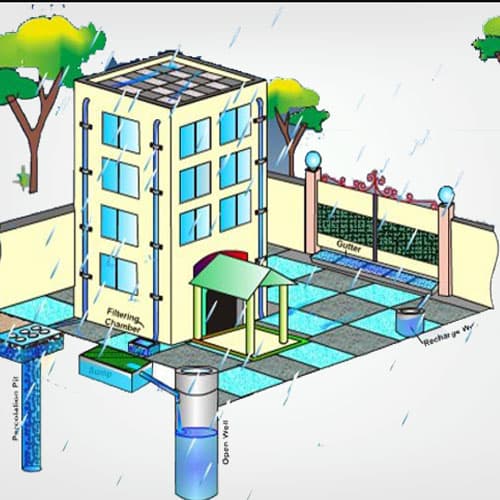
What is Industrial Rainwater Harvesting?
Industrial rainwater harvesting is the process of collecting rainwater from large industrial catchment areas such as factory rooftops, warehouses, sheds, parking areas, and paved surfaces.
The collected rainwater is passed through suitable filtration and treatment arrangements before being stored or used for groundwater recharge. Depending on the quality of the harvested water and its intended application, additional treatment may also be required.
A typical industrial system consists of:
- Rainwater collection surfaces
- Gutters and drainage channels
- Collection pipes
- First-flush arrangements
- Filtration units
- Storage tanks or underground storage systems
- Recharge pits, trenches, or wells
- Modular underground harvesting systems
- Pumps and distribution arrangements, where required
The system can be designed according to the size, layout, water demand, rainfall pattern, and site conditions of the industrial facility.
Why Do Industries Need Rainwater Harvesting?
Large industrial properties often have extensive rooftops and paved areas. During the monsoon, these surfaces can generate significant quantities of rainwater.
Without proper management, much of this water may leave the premises as surface runoff. At the same time, the facility may continue depending on groundwater, municipal water, tankers, or other external sources.
Industrial rainwater harvesting helps address this gap by making productive use of rainwater available on the site.
Major advantages include:
Reduced Dependence on Freshwater Sources
Harvested rainwater can supplement existing water sources for suitable industrial and utility applications.
Groundwater Recharge
Where site conditions are suitable, rainwater can be directed into recharge structures to support groundwater replenishment.
Water Conservation
Capturing rainwater prevents a valuable natural resource from being unnecessarily lost as runoff.
Lower Water Procurement Costs
Using harvested water for suitable applications can reduce the quantity of water that needs to be purchased or sourced externally.
Better Stormwater Management
Properly designed systems can help manage runoff from large rooftops and paved areas.
Environmental Sustainability
Rainwater harvesting supports responsible resource management and can contribute to an industry's broader sustainability initiatives.
How Does an Industrial Rainwater Harvesting System Work?
An industrial rainwater harvesting system generally follows a series of stages.
1. Collection
Rainwater is collected from suitable surfaces such as factory roofs, warehouse roofs, sheds, and other approved catchment areas. Drainage channels and pipes transfer the collected water toward the harvesting system.
2. First-Flush Diversion
The first rainfall after a dry period may carry dust, leaves, dirt, and other materials accumulated on the catchment surface. A first-flush arrangement can divert this initial flow before the main collection process begins.
3. Filtration
The collected water passes through an appropriate filtration system. Filters can remove suspended particles and other physical impurities before the water enters storage or recharge structures.
The filtration arrangement should be selected according to the catchment conditions and intended use of the water.
4. Storage or Recharge
After filtration, rainwater can be stored in tanks or underground systems for later use. Alternatively, where geological and site conditions permit, it can be directed into groundwater recharge structures.
5. Reuse
Stored rainwater can be used for suitable applications such as landscaping, gardening, cleaning, toilet flushing, vehicle washing, and other utility requirements.
If rainwater is intended for potable or process applications, appropriate treatment and water-quality testing should be carried out according to the required standards.
Applications of Industrial Rainwater Harvesting
Industrial rainwater harvesting can be used across many types of facilities, including:
The exact application of harvested rainwater depends on the water quality, treatment system, and operational requirements of the facility.
Modular Industrial Rainwater Harvesting Systems
Large industrial sites may have limited open space or challenging soil and infrastructure conditions. In such situations, modular rainwater harvesting systems can provide an efficient underground solution.
Modular systems use specially designed underground structures to create storage or infiltration capacity beneath areas such as parking spaces, driveways, landscaped zones, and other suitable locations.
They can offer several advantages:
- ✓Efficient use of underground space
- ✓Flexible system configuration
- ✓High storage capacity in a relatively compact footprint
- ✓Suitability for large-scale projects
- ✓Reduced requirement for conventional surface storage
- ✓Integration with existing stormwater infrastructure
The appropriate system should be selected after evaluating the site's structural, hydraulic, geological, and operational requirements.
Factors to Consider Before Installation
An industrial rainwater harvesting system should be designed according to the specific characteristics of the site.
Important factors include:
A proper site assessment helps determine the appropriate collection, filtration, storage, and recharge arrangement.
Maintenance of Industrial Rainwater Harvesting Systems
Regular maintenance is important for maintaining system performance.
Recommended activities include:
Routine inspection is particularly important before and during the monsoon season.
A Practical Step Toward Sustainable Industrial Water Management
Industrial rainwater harvesting provides industries with a practical method of conserving rainwater and improving overall water management. By collecting rainwater from large available catchment areas, industries can create an additional water resource while reducing unnecessary runoff.
From conventional rooftop harvesting and groundwater recharge to advanced filtration and modular underground systems, the solution can be customized according to the facility's requirements.
With proper planning, quality components, suitable filtration, and regular maintenance, Industrial Rainwater Harvesting can help businesses use water more efficiently, reduce pressure on freshwater resources, and move toward a more sustainable industrial future.
Plan Your Industrial Rainwater Harvesting System
Every industrial site has different rainfall conditions, catchment areas, water requirements, and ground conditions. A site-specific assessment is therefore essential for developing an efficient solution.
A professionally designed system can combine rainwater collection, filtration, storage, groundwater recharge, and reuse to create a complete industrial water management solution.
Capture rainwater today, manage it efficiently, and turn every rainfall event into a valuable water resource for your industrial facility.